
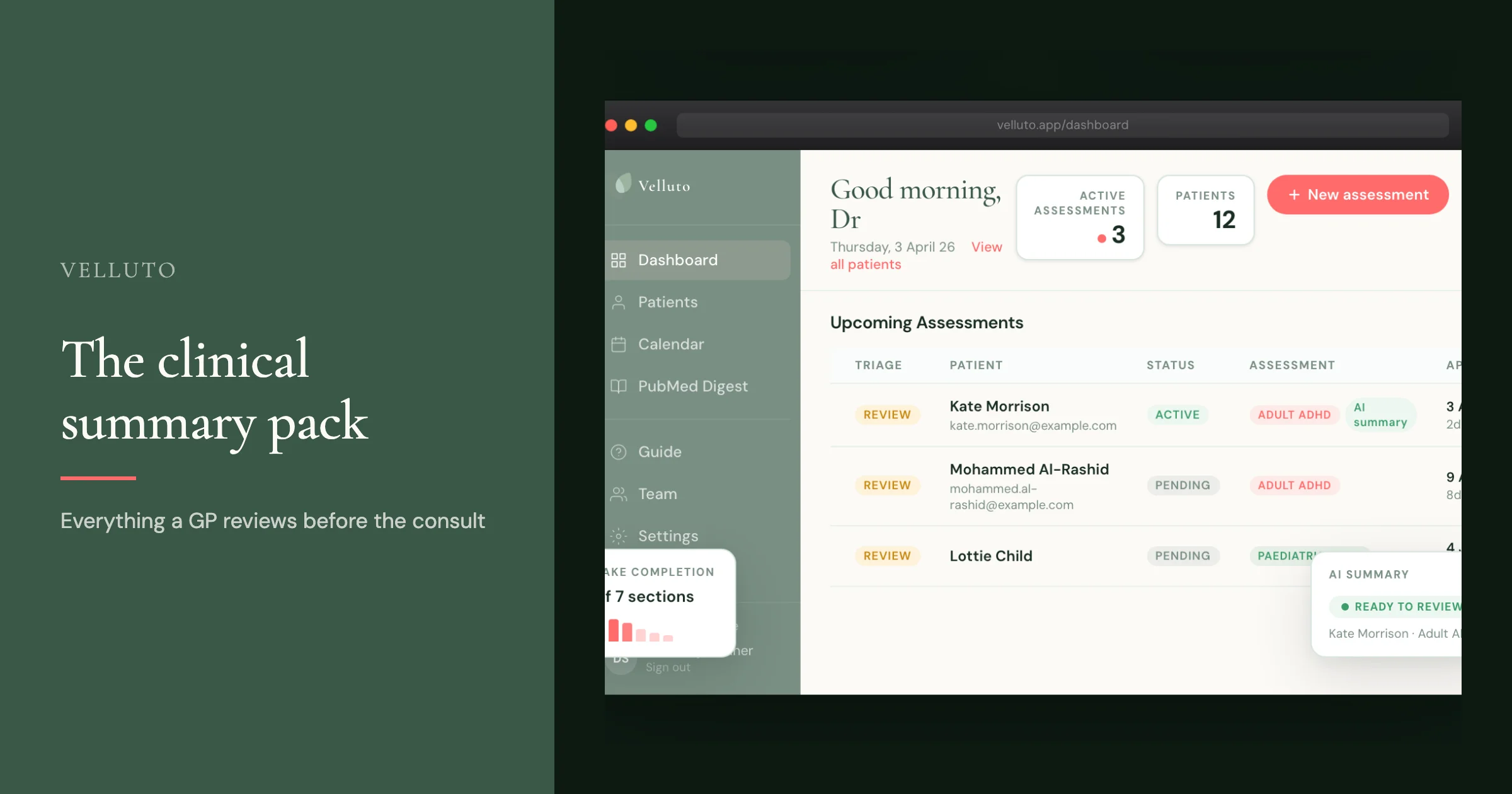
Before a patient sits down for their first ADHD consultation, Velluto assembles a clinical summary pack and delivers it to the GP’s dashboard. The GP reviews it before the appointment begins. This post is a factual walkthrough of what that pack contains.
Quick links
- At a glance: clinical summary pack components
- What is a clinical summary pack?
- What does a GP receive before the consultation?
- What scored questionnaires are included?
- How is observer data presented alongside self-report?
- What does the AI-generated clinical summary include?
- What is the readiness score and how should it be read?
- How are supporting documents presented?
- Where do response validity flags appear?
- How does the GP access and export the summary?
- What does the GP do with the pack?
- Frequently asked questions
At a glance: clinical summary pack components
| Component | What it contains |
|---|---|
| Questionnaire score sheet | ASRS v1.1 subscale scores with reference thresholds. Raw numbers only, no interpretation. |
| Observer and informant reports | Scored responses from each nominated observer. Settings, relationship to patient, duration of observation. |
| Childhood evidence summary | Key phrases extracted from uploaded school reports, organised chronologically by AI. |
| Inconsistency flags | Self-report vs observer discrepancies. Questionnaire answers vs medical history contradictions. |
| Differential diagnosis flags | Conditions flagged from patient-reported history (thyroid, PTSD, substance use, mood disorders, anxiety). |
| Gaps report | What is missing or incomplete. Whether the consultation can proceed or rescheduling is recommended. |
| Response validity flags | Five-signal data quality summary (GP-only, never shown to the patient). |
| Readiness score | Green / Amber / Red based on data completeness and quality. |
| AI-generated clinical summary | Structured narrative presenting patient-reported data for GP review. Inline citations map every statement to its source. |
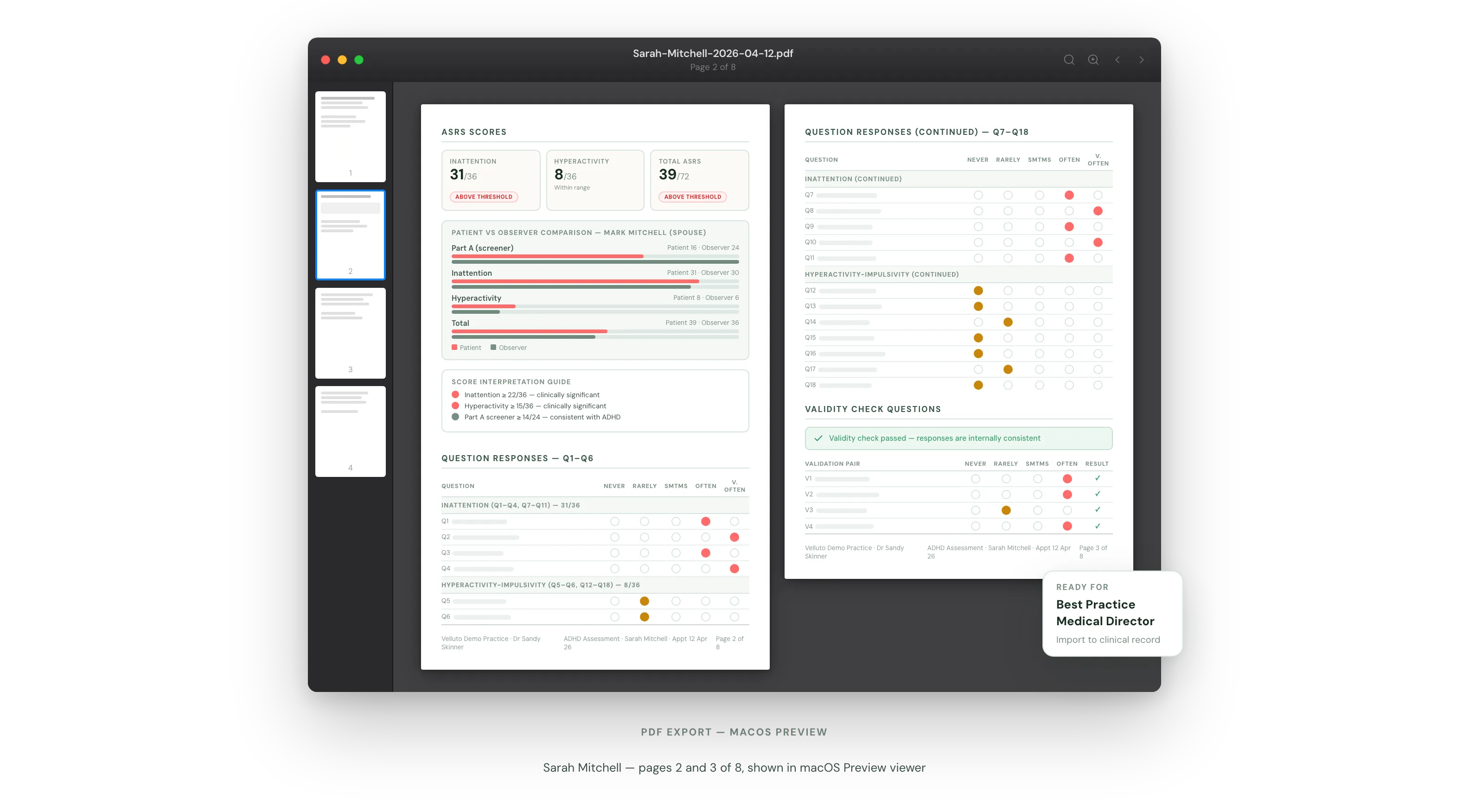
The pack is viewable in the GP dashboard. It is also downloadable as a PDF for attachment to Best Practice or Medical Director.
What is a clinical summary pack?
A clinical summary pack is a structured pre-consultation document that organises everything the patient and their nominated observer reported before the appointment. It is generated by Velluto once sufficient intake data is collected, and it is made available to the GP before the consultation begins.
The pack does not make clinical recommendations. It presents collected data in a structured format so the GP can review the evidence before the patient arrives, rather than spending the consultation gathering it.
Velluto’s job ends when the GP opens the pack. The consultation, the clinical interview, and all diagnostic decisions are the GP’s.
What does a GP receive before the consultation?
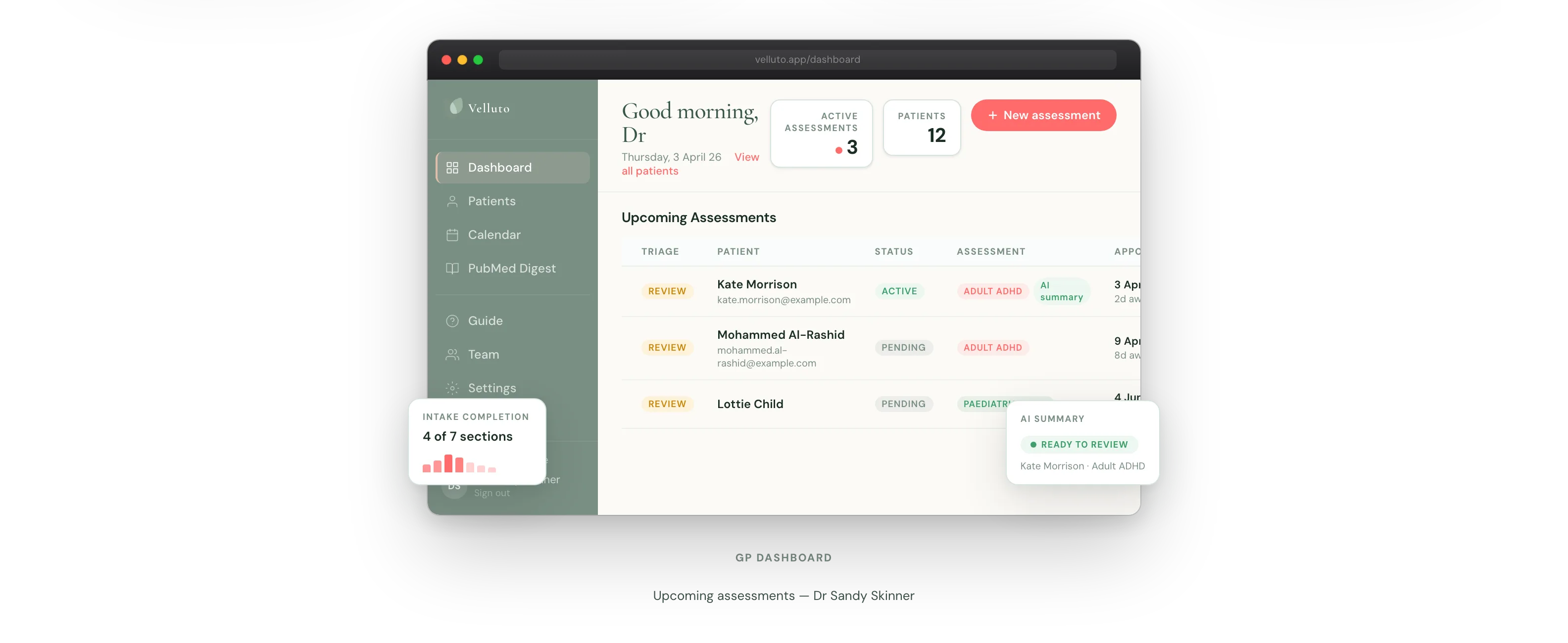
When the patient completes their pre-appointment intake through Velluto, the GP’s dashboard shows real-time completion status for each section. Once enough data is collected, the full clinical summary pack is available to view.
The pack contains:
- Scored ASRS v1.1 questionnaire results, with inattention and hyperactivity-impulsivity subscale scores and reference thresholds
- Observer report scores from each nominated observer (up to two for adult assessments), with the observer’s relationship to the patient and the settings they observed
- Childhood evidence extracted from uploaded school reports and historical documents
- Inconsistency flags where the self-report data and observer data diverge, or where questionnaire answers contradict the medical history
- Differential diagnosis flags drawn from the patient’s own reported medical history
- A gaps report documenting what was not completed before the appointment
- Response validity flags from the five-signal data quality model (visible to the GP only)
- A readiness score (Green, Amber, or Red)
- An AI-generated clinical summary narrative with inline source citations
The GP can also subscribe to a calendar iCal feed, colour-coded by readiness score, that shows which upcoming appointments have complete, partial, or missing intake data.
What scored questionnaires are included?
For adult ADHD assessments, Velluto administers the ASRS v1.1 (Adult ADHD Self-Report Scale, version 1.1). This is a validated 18-item self-report screening instrument mapped to DSM-5 ADHD symptom criteria.
Velluto’s implementation includes:
- 18 core ASRS items, presented one at a time with randomised question order
- 6 validation questions paired with core items to check internal consistency
- 4-6 context questions (randomised placement)
- Two subscales: inattention and hyperactivity-impulsivity
- Maximum raw score: 72
- Clinical threshold: 5/9 symptom count
Scoring is deterministic arithmetic. The GP can verify any score by checking the raw patient responses. No AI is involved in the scoring calculation.
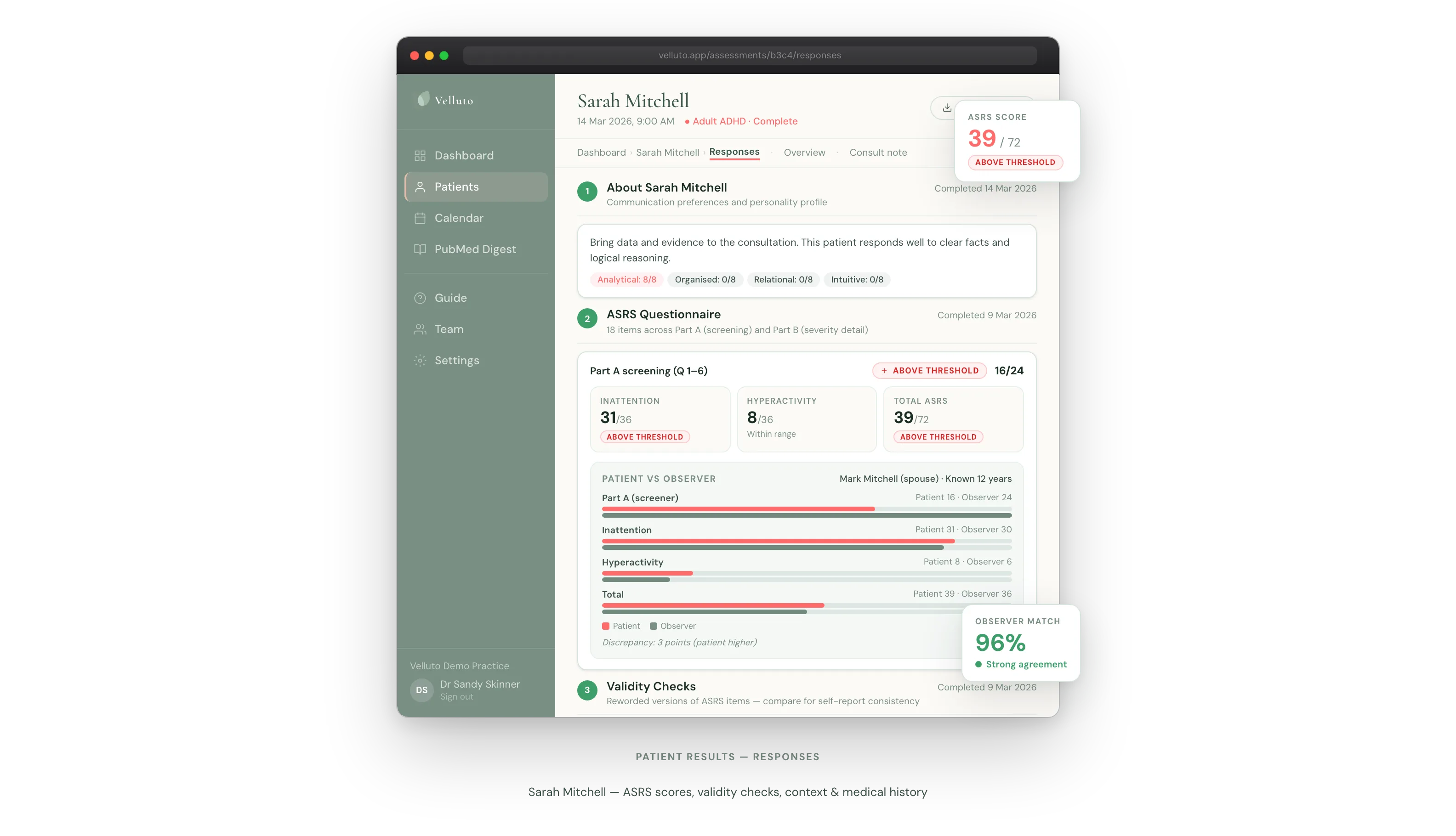
The score sheet in the clinical summary pack shows subscale scores with reference thresholds. It presents raw numbers without clinical interpretation. Interpreting those numbers is the GP’s role.
The observer also completes a questionnaire: 18 DSM-5 items in third-person format plus a free-text section. Observer scores are presented alongside the patient self-report on the same score sheet so the GP can see both at a glance.
How is observer data presented alongside self-report?
The observer report sits alongside the patient self-report in the clinical summary pack. The GP sees both sets of scores on the same page.
For each observer, the pack shows their subscale scores on the same 18 DSM-5 items the patient answered, the settings they observed the patient in, their relationship to the patient and how long they have known them, and a free-text section for anything outside the structured items.
Where the patient’s self-report and the observer’s report diverge, Velluto flags the discrepancy in the inconsistency section. The pack does not interpret what a discrepancy means clinically. It shows the GP the direction and magnitude of the difference and leaves the clinical discussion for the consultation.
If the patient did not nominate an observer, the GP is notified in the summary. This absence is documented, not silently omitted. The readiness score reflects whether observer data is present.
What does the AI-generated clinical summary include?
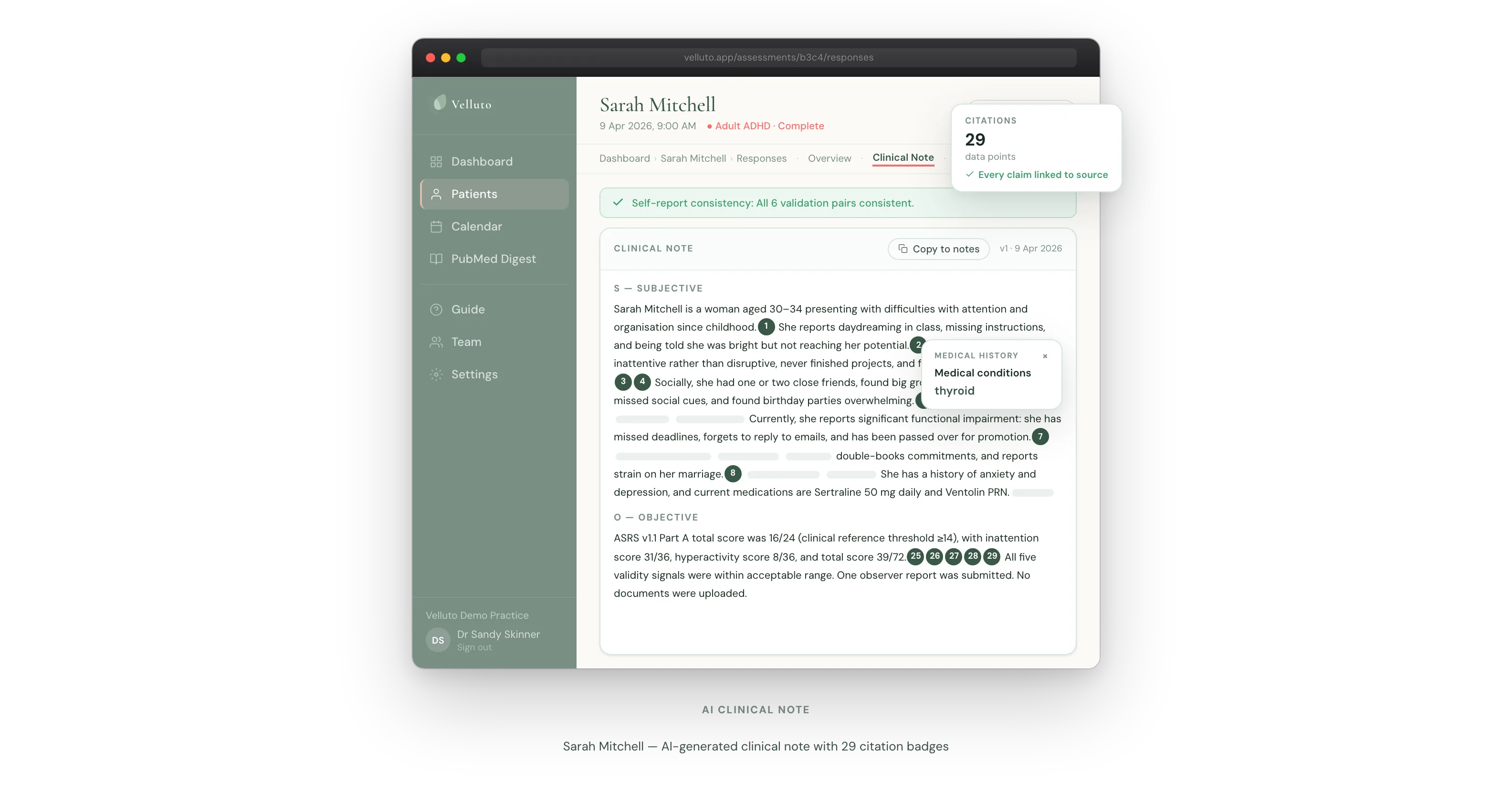
The AI-generated clinical summary is a structured narrative that organises and presents the patient’s reported data for the GP to review. It is produced by Claude Sonnet (AWS Bedrock, hosted in Sydney) after the patient completes their intake.
The summary presents: patient-reported ASRS scores and subscale breakdown; observer scores and any discrepancy with self-report; relevant medical and mental health history as reported by the patient; childhood self-report and any key phrases extracted from uploaded school documents; functional impact across work, relationships, and daily life as reported by the patient; thinking style responses; and any differential diagnosis flags drawn from the patient-reported history.
Every statement in the summary is cited back to the specific data it came from. The inline citations are visible to the GP so they can trace any claim in the narrative to its source.
What the AI-generated summary does not include: a diagnosis or diagnostic suggestion; a treatment recommendation; a prescribing suggestion; any clinical interpretation of scores; any conclusion about whether the patient has ADHD. The AI organises and presents data. It does not analyse, recommend, or decide. The GP reads the summary and forms their own clinical view.
Before the summary is generated, patient names, GP names, and practice names are de-identified and replaced with tokens. All AI processing is hosted in Australia. No patient data is used to train AI models.
What is the readiness score and how should it be read?
The readiness score is a data completeness indicator. It tells the GP how much of the expected intake data is present before the consultation. It is not a measure of clinical severity. A Green score does not mean the patient has ADHD. A Red score does not mean they do not.
| Score | Meaning |
|---|---|
| Green | All required intake sections are complete. Observer data is present. The consultation can proceed with a full clinical picture. |
| Amber | Some sections are incomplete or observer data is missing. The consultation can proceed, but the GP should note what is absent. |
| Red | Critical evidence is missing. Rescheduling may be worth considering. |
The gaps report in the clinical summary pack documents exactly what is incomplete when the score is Amber or Red. The GP decides whether to proceed.
How are supporting documents presented?
When a patient uploads school reports, specialist letters, or historical medical records, Velluto extracts key information from those documents automatically. The extraction uses Google Vertex AI (hosted in Australia).
The childhood evidence summary in the clinical summary pack shows: key phrases and findings extracted from uploaded documents; the approximate date of each document; the patient’s approximate age at the time; any prior diagnoses or prior medications mentioned in the document. Extractions are organised chronologically so the GP can see the developmental history in sequence without reading each document in full.
The original documents are also available in the dashboard. The GP can open the original PDF directly if they want to verify a phrase in context or read sections the extraction did not capture.
Where do response validity flags appear?
Response validity flags are part of the clinical summary pack and are visible to the GP only. The patient never sees them.
Velluto’s five-signal validity model checks:
| Signal | What it checks |
|---|---|
| V1: Self-report consistency | Do the 6 validation question pairs match their corresponding ASRS answers? |
| V2: Severity distribution | Is the pattern of scores clinically plausible? |
| V3: Completion speed | Average time per question. Under 3 seconds per question suggests the patient was not reading the questions. |
| V4: Self-report vs observer | Do the two sources agree on symptom severity? |
| V5: Childhood onset | Does the stated age of onset match the childhood self-report section? |
All five signals are deterministic and rule-based. No AI is involved in the validity calculations. The pack does not interpret what validity flags mean about the patient. It presents the pattern. The GP decides what to do with it during the clinical interview.
How does the GP access and export the summary?
The clinical summary pack is available in the GP’s Velluto dashboard as soon as sufficient intake data is collected. The GP can open it on any device with a browser. No software installation is required.
To export: click the download button on any assessment in the dashboard. The pack generates as a PDF. The GP or a clinical staff member with appropriate access can attach the PDF to the patient record in Best Practice or Medical Director.
The current workflow is a manual PDF attachment step. The PDF contains sensitive clinical assessment data, so practices should consider which staff role handles this step. Direct integration with Best Practice via Halo Connect is on the product roadmap and would remove the manual step.
What does the GP do with the pack?
The GP reviews the clinical summary pack before the consultation. The pack is not a clinical decision. It is pre-consultation preparation material. The GP reads it, forms an initial picture, and then conducts the clinical interview using their own judgement.
Everything that happens after the GP opens the pack is clinical practice: the diagnostic interview, the clinical reasoning, the documentation in Best Practice, and any diagnosis or treatment decision. Velluto does not diagnose ADHD. The GP diagnoses. Velluto collects, scores, flags, and presents. The clinical record of the consultation lives in Best Practice, not in Velluto.
That is the intended purpose of the pack. The GP decides everything that follows. If you want to see how the pack looks for a specific patient type, you can start a 14-day free trial at velluto.app. No credit card required.
Related in this series
Companion posts on how Velluto prepares the evidence before an ADHD consultation.
ASRS v1.1 questionnaire: what GPs need to know about administering it properly
Proper administration of the ASRS v1.1 in general practice, and what digital delivery changes.
Observer reports in GP ADHD assessment: what they are and why they change the consultation
How observer reports change the quality of evidence before the consultation.
Childhood school reports in adult ADHD assessment
Using school reports and developmental records as childhood onset evidence in adult ADHD assessment.
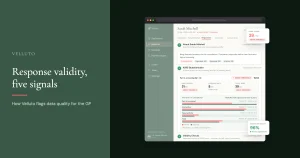
Response validity in ADHD screening: the five-signal model
The five deterministic signals Velluto checks to flag data quality issues.
Frequently asked questions
What is the Velluto clinical summary pack?
The Velluto clinical summary pack is a structured pre-consultation document delivered to the GP’s dashboard before an ADHD assessment appointment. It contains scored ASRS questionnaire results, observer report data, extracted childhood evidence from uploaded documents, inconsistency flags, differential diagnosis flags, a response validity summary, a readiness score, and an AI-generated clinical narrative. Every AI-generated statement is cited back to its source data. The pack does not make clinical recommendations. The GP reviews it and makes all clinical decisions.
What scored questionnaire does Velluto use for adult ADHD assessments?
Velluto uses the ASRS v1.1 (Adult ADHD Self-Report Scale, version 1.1). This is an 18-item validated screening instrument mapped to DSM-5 ADHD symptom criteria. It includes two subscales: inattention and hyperactivity-impulsivity. Maximum raw score is 72 and clinical threshold is 5/9. Scoring is deterministic arithmetic, not AI. The GP can verify any score from the raw patient responses.
What does the AI-generated clinical summary include?
The AI-generated clinical summary organises and presents the patient’s reported data as a structured narrative for the GP to review. It covers ASRS scores, observer data, medical and mental health history, childhood self-report, document extractions, and functional impact. Every statement is cited to its source. The summary does not include a diagnosis, treatment recommendation, or clinical interpretation. The AI presents data; the GP draws clinical conclusions.
What is the readiness score in the Velluto dashboard?
The readiness score is a data completeness indicator, not a measure of clinical severity. Green means all required intake sections are complete and the consultation can proceed with a full clinical picture. Amber means some data is incomplete; the consultation can proceed, but the GP should note what is absent. Red means critical evidence is missing and rescheduling may be worth considering. The GP decides whether to proceed regardless of the score.
How does Velluto handle response validity?
Velluto’s five-signal validity model checks internal consistency, severity distribution, completion speed, self-report vs observer agreement, and childhood onset consistency. All five checks are deterministic and rule-based. No AI is involved. Validity flags are GP-only information and are never shown to the patient. The pack presents the pattern; the GP decides what to discuss during the clinical interview.
How does a GP export the clinical summary to Best Practice?
The GP downloads the clinical summary pack as a PDF from the Velluto dashboard. A GP or clinically authorised staff member can then attach the PDF to the patient record in Best Practice or Medical Director. The PDF includes all pack components: scored questionnaires, observer data, childhood evidence, flags, readiness score, and the AI-generated summary. Direct integration with Best Practice via Halo Connect is on the Velluto roadmap and would replace this manual step.
Does Velluto diagnose ADHD?
No. Velluto does not diagnose ADHD or any other condition. It collects structured patient and observer data, scores validated questionnaires using published methods, flags data quality patterns, and presents the organised picture to the GP before the consultation. The GP conducts the diagnostic interview, applies clinical judgement, and makes all diagnostic and treatment decisions. The clinical record lives in Best Practice, not in Velluto.
Clinical information disclaimer
This article contains general clinical information for healthcare professionals. It is not a substitute for individual clinical judgement, professional guidelines, or specific patient assessment. Always apply your own clinical reasoning when making treatment decisions.
Velluto is a clinical intake platform. It does not diagnose, recommend treatment, or make clinical decisions. All clinical decisions remain with the treating GP.