
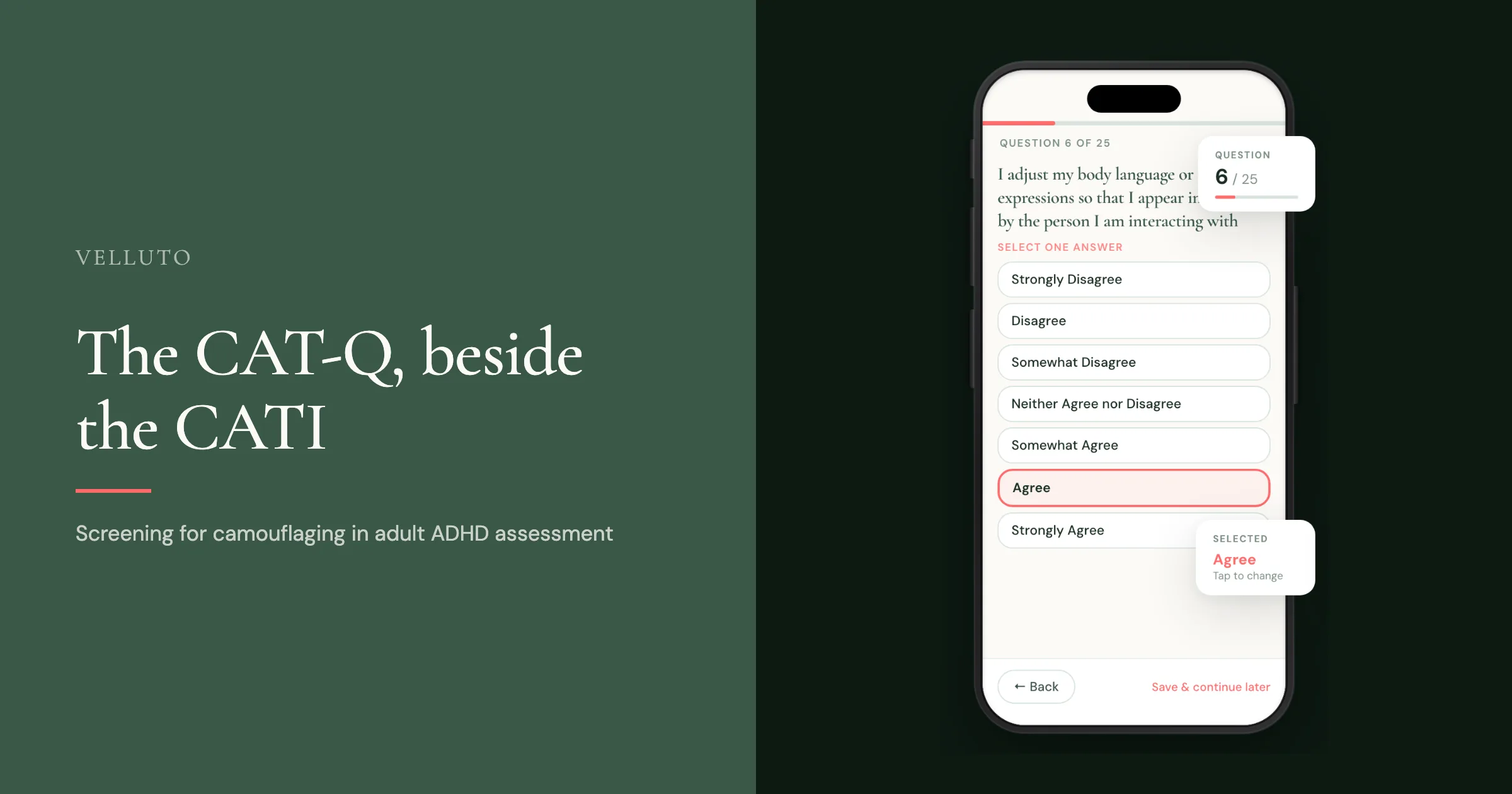
The CAT-Q questionnaire (Camouflaging Autistic Traits Questionnaire) is a 25-item self-report screening instrument that measures how much effort a person puts into hiding or compensating for autistic traits, developed by Hull, Mandy, Lai and colleagues and validated in 2019. It is the instrument Velluto sends alongside the CATI on an adult ADHD assessment, for GPs considering whether autism might explain a presentation that ADHD assessment alone does not fully account for.
New in Velluto, September 2026. The CAT-Q is now available to every Velluto practice as a screening instrument. You will find it under Add screening on any adult ADHD assessment, and as a tick box under Request review, beside the CATI, K10, GAD-7, PHQ-9, OCI-R and DASS-21. Nothing is sent by default: a GP chooses it for the patient it suits. This post explains what the instrument measures, how it is scored, why it sits beside the CATI rather than inside it, and exactly what a GP sees when the result comes back.
Quick links
- At a glance
- What is the CAT-Q questionnaire and what does it measure?
- How is the CAT-Q structured (items, factors and scoring)?
- Is there a clinical cut-off for the CAT-Q?
- Why send the CAT-Q beside the CATI?
- When should a GP consider camouflaging in an adult ADHD assessment?
- What does proper administration require in general practice?
- What does digital delivery change?
- What does Velluto do with the CAT-Q?
- How does the CAT-Q result appear in the clinical summary and PDF?
- Frequently asked questions
At a glance
| Feature | Detail |
|---|---|
| Developer | Hull, Mandy, Lai, Baron-Cohen, Allison, Smith and Petrides |
| Year | 2019 |
| Items | 25 |
| Factors | Compensation (9 items), Masking (8 items), Assimilation (8 items) |
| Response format | 7-point scale (Strongly Disagree to Strongly Agree) |
| Score ranges | Total 25 to 175. Compensation 9 to 63. Masking and Assimilation 8 to 56 each. |
| Clinical threshold | None published |
| Administration time | 5 to 10 minutes |
| Who completes it | The patient (self-report), adults 18 and over |
| Diagnostic status | Screening instrument only. Not a diagnostic tool. |
| Licence | CC BY 4.0 |
Patients complete each CAT-Q item on their own device, one question at a time, before the appointment. There is no login, no account, and no time limit.
What is the CAT-Q questionnaire and what does it measure?
The CAT-Q measures camouflaging: the strategies autistic people use to manage social interaction so that it looks, from the outside, like it does not cost them anything. Hull, Mandy, Lai and colleagues built the instrument around three factors. Compensation covers active strategies used to work around social difficulty, such as rehearsing conversation topics or copying behaviour learned from watching others. Masking covers suppressing autistic traits and presenting a different persona, such as monitoring facial expression or forcing eye contact. Assimilation covers the effort spent trying to fit in with a group, such as forcing interaction that would otherwise be avoided.
The CAT-Q does not measure autistic traits directly. It measures the work a person does to manage how those traits are seen. That distinction matters clinically. A patient can present as socially capable and still be worn out by the effort behind it, and a trait inventory that only asks what a person does will not capture that gap. The CAT-Q asks what the effort itself costs.
The instrument was published in the Journal of Autism and Developmental Disorders in 2019 and is released under a Creative Commons Attribution 4.0 licence, which is why Velluto can reproduce the items directly rather than paraphrasing them.
How is the CAT-Q structured (items, factors and scoring)?
The CAT-Q has 25 items on a seven-point scale, from Strongly Disagree to Strongly Agree. Each item is scored 1 to 7, with higher scores reflecting more camouflaging.
The 25 items divide into three factors, unequal in size:
- Compensation (9 items, range 9 to 63): active strategies to work around social difficulty, including scripting, rehearsing and modelling behaviour learned from others.
- Masking (8 items, range 8 to 56): suppressing autistic traits and presenting a different persona, including monitoring facial expression and adjusting body language.
- Assimilation (8 items, range 8 to 56): effort spent trying to fit in with a group, including forcing social interaction and feeling like the patient is “performing” rather than being themselves.
A total across all 25 items runs 25 to 175.
Five items are reverse-scored: items 3, 12, 19, 22 and 24. These are the items phrased as the absence of effort (“I rarely feel the need to put on an act”, “I feel free to be myself when I am with other people”), and the reversed value is 8 minus the raw score. Three of the five sit in Assimilation and two in Masking. Compensation has none.
Scoring is arithmetic. There is no weighting, no algorithm and no judgement involved in calculating a score. The patient’s answers produce the same three factor sums and the same total regardless of who is reading them. What the GP does with those numbers is a separate question, covered below.
Is there a clinical cut-off for the CAT-Q?
No. The CAT-Q has no published clinical cut-off. The validation study reports group averages only, as per-item means on the 1 to 7 scale, for an autistic sample and a non-autistic sample:
| Factor | Autistic group average | Non-autistic group average |
|---|---|---|
| Total | 4.79 | 3.48 |
| Compensation | 4.42 | 2.89 |
| Masking | 4.55 | 4.29 |
| Assimilation | 5.29 | 3.32 |
These are reference figures from the original validation study, not a threshold a patient’s score is measured against. A GP reading a patient’s result can see it sitting closer to one group average or the other, but the instrument does not convert that into a verdict, and neither does Velluto.
The Masking factor deserves particular caution. The validation study found it showed the smallest gap between the two groups of the three factors, and no significant relationship to autistic-like traits within the autistic sample. A high Masking score alone is weaker evidence than a high Compensation or Assimilation score, and Velluto states that caveat on the result itself rather than leaving it to be found in the original paper.
Why send the CAT-Q beside the CATI?
Velluto already offers the CATI (Comprehensive Autistic Trait Inventory), a 42-item self-report across six subscales that reports how many autistic traits a patient describes. The CAT-Q asks a different question: not how many traits, but how much effort the patient spends managing how those traits present.
The CATI’s own Social Camouflage subscale covers some of this ground already, mapping loosely onto Compensation and Assimilation. It has little on Masking in the CAT-Q sense: suppressing behaviour rather than working around it. That gap is the reason the two instruments sit side by side rather than one replacing the other.
A patient who camouflages heavily can score modestly on a trait inventory, because the inventory measures the presentation rather than the effort behind it. Sent together, the CATI and the CAT-Q give a GP two figures that answer different questions: what the patient’s traits look like, and how much work goes into managing how those traits are seen.
The CAT-Q is never bundled into the CATI. It is sent as its own screening request, so a GP chooses to send it deliberately rather than receiving it automatically with every autism-related screen.
When should a GP consider camouflaging in an adult ADHD assessment?
ADHD and autism can co-occur, and a patient assessed for ADHD may have autistic traits that were never picked up, particularly if their presentation has always looked capable from the outside. Camouflaging is one reason that happens.
Consider the CAT-Q when a patient’s history includes long-developed social strategies they can describe in detail: rehearsed scripts for small talk, close observation and copying of other people’s behaviour, or exhaustion after social situations that looked, from the outside, like they went fine. Consider it too when a patient’s presentation differs sharply by setting, composed and functional at work, depleted at home, because that kind of split effort is exactly what the CAT-Q’s three factors are built to capture.
None of this is a checklist for diagnosis. It is a prompt to consider whether a second instrument, sent alongside the ADHD screening already under way, would give a clearer picture before a referral decision is made. The CAT-Q does not tell a GP whether to refer. It gives them one more piece of structured information to weigh alongside everything else on file.
What does proper administration require in general practice?
Setting
The patient should complete the CAT-Q privately, without anyone else present or assisting, and without being told in advance what a particular pattern of answers would suggest. As with any self-report instrument, a clinician’s presence during completion can shift answers toward what the patient believes is expected.
Explanation before completion
Before the patient begins, they should understand that the questionnaire asks about strategies they use in social situations, and that there are no right or wrong answers. Do not describe what a heavily camouflaged answer pattern looks like. Naming the pattern in advance shapes answers toward or away from it.
Who completes it
The CAT-Q is self-report only. There is no observer version and no published version for a parent, teacher or partner to complete, because camouflaging is largely invisible to an observer by definition. The GP does not complete it on the patient’s behalf from clinical observation.
Time
Five to ten minutes is typical. There is no benefit to rushing a patient through it, and no clinical reason to impose a time limit.
What does digital delivery change?
When the patient completes the CAT-Q on their own device, at their own pace, outside the clinical setting, several of the conditions above are easier to meet by default. There is no clinician in the room, no waiting-room time pressure, and no risk that a staff member glances at answers while the patient works through them.
One-question-at-a-time presentation, the same approach Velluto uses for its other self-report instruments, means the patient answers each item without seeing the full list first, which reduces the chance of planning a response pattern in advance.
Because there is no observer version of the CAT-Q, digital delivery does not introduce a comparison or discrepancy question the way it does for the CATI’s observer variant or for ADHD’s own collateral reports. The CAT-Q produces one figure, from one respondent, and digital delivery’s main contribution is making sure that figure is collected under calm, unhurried conditions.
What does Velluto do with the CAT-Q?
A GP sends the CAT-Q from Add screening on an existing assessment, or ticks it under Request review, where it is held until the appointment is dated and then sent automatically with the rest of the intake, the same pattern Velluto uses for every screening instrument.
The patient completes it on their own device. There is no login and no account: the link they receive opens the questionnaire directly, and it can be started and finished in one sitting inside the 5 to 10 minutes it typically takes.
The CAT-Q is never bundled automatically into a CATI request. A GP ticks it deliberately, for the patients where camouflaging is worth a second look, rather than receiving it as a default extra on every autism-related screen.
How does the CAT-Q result appear in the clinical summary and PDF?
Once the patient has completed it, the result appears on the assessment’s Responses tab beside the CATI. Three factor tiles show Compensation, Masking and Assimilation as sums against each factor’s own range, plus a total across all 25 items. Beside each figure, Velluto shows the patient’s own per-item average next to the equivalent published figure from the validation study’s autistic and non-autistic groups, so the two sit on the same basis without either being converted into a verdict.
The Masking tile carries its own caveat, stating in the GP’s copy that it is the least specific of the three factors in the validation study. Reverse-scored items are marked on the clinician’s copy, so a GP checking an individual response can see which of the 25 items were reversed before the factor sums were calculated.
The same result appears in the downloadable PDF alongside the CATI, with an attribution footer: the full citation to Hull, Mandy, Lai and colleagues (2019), a link to the CC BY 4.0 licence, and a note of the two changes Velluto has made to the original item wording. Neither change affects scoring.
Scoring throughout is deterministic arithmetic. Nothing about the factor sums, the total, or the published comparison figures is interpreted, weighted or summarised automatically. What reaches the GP is the same set of numbers a person scoring the paper form by hand would produce, read beside the CATI rather than in place of it.
Closing
The CAT-Q is a well-validated, freely licensed instrument for a question Velluto’s existing autism screening did not fully answer: not how many autistic traits a patient describes, but how much effort sits behind the presentation. Sent beside the CATI, it gives a GP two figures instead of one, and neither carries a verdict.
There is no cut-off to apply and no shortcut to a referral decision. What the CAT-Q gives a GP is a second, structured piece of evidence, collected under calm conditions before the appointment, to weigh alongside everything else already on file.
The GP decides what to make of it. Velluto’s job stops at presenting the numbers clearly.
Related in this series
Companion posts on how Velluto prepares the evidence before an ADHD consultation.
ASRS v1.1 questionnaire: what GPs need to know about administering it properly
Proper administration of the ASRS v1.1 in general practice, and what digital delivery changes.
Observer reports in GP ADHD assessment: what they are and why they change the consultation
How observer reports change the quality of evidence before the consultation.
What a GP receives before an ADHD consultation with Velluto
What a GP receives before an ADHD consultation, scored and cross-referenced.
Frequently asked questions
What is the CAT-Q questionnaire used for?
The CAT-Q questionnaire measures camouflaging: the effort an autistic person spends hiding or compensating for their traits in social situations. GPs use it alongside the CATI on an adult ADHD assessment, for patients where autism might explain a presentation ADHD screening alone does not fully account for. It is a screening instrument, not a diagnostic one.
Is the CAT-Q free to use?
Yes. The CAT-Q is released under a Creative Commons Attribution 4.0 licence, which permits reproduction with attribution, a link to the licence, and a note of any changes made. Velluto meets all three requirements on every CAT-Q result it displays.
Can a GP diagnose autism with the CAT-Q?
No. GPs cannot diagnose autism under the current Australian pathway. Diagnosis sits with a paediatrician, psychiatrist or clinical psychologist applying DSM-5-TR. The CAT-Q result supports a referral decision. It does not produce a diagnosis on its own or in combination with any other Velluto instrument.
What is a normal CAT-Q score?
There is no published normal range for an individual score. The validation study reports average per-item scores for two group samples, autistic and non-autistic, not a cut-off an individual is measured against. A patient’s result can be read beside those published averages, but neither number sorts a person into a category.
Is there a CAT-Q for children or an observer version?
No. The CAT-Q was validated in adults and Velluto administers it to patients 18 and over, the same floor as the CATI. There is no observer version, because camouflaging is largely invisible to an observer by definition, and no published version exists for a parent, teacher or partner to complete.
How is the CAT-Q different from the CATI?
The CATI reports how many autistic traits a patient describes, across six subscales. The CAT-Q reports how much effort they put into managing how those traits present, across three factors: Compensation, Masking and Assimilation. They measure different things and are sent as separate screening requests, one never folded into the other.
Where can I read the original CAT-Q validation study?
The CAT-Q was published by Hull, Mandy, Lai, Baron-Cohen, Allison, Smith and Petrides in the Journal of Autism and Developmental Disorders in 2019 (doi.org/10.1007/s10803-018-3792-6). The paper and its supplementary scoring file are the source Velluto transcribes the items from.
References
Hull, L., Mandy, W., Lai, M.-C., Baron-Cohen, S., Allison, C., Smith, P., & Petrides, K. V. (2019). Development and Validation of the Camouflaging Autistic Traits Questionnaire (CAT-Q). Journal of Autism and Developmental Disorders, 49(3), 819-833. doi:10.1007/s10803-018-3792-6
English, M. C. W., Gray, K. M., et al. (2021). The Comprehensive Autistic Trait Inventory (CATI): development and validation of a new measure of autistic traits in the general population. Molecular Autism, 12, 37. doi:10.1186/s13229-021-00445-7
Clinical information disclaimer
This article contains general clinical information for healthcare professionals. It is not a substitute for individual clinical judgement, professional guidelines, or specific patient assessment. Always apply your own clinical reasoning when making treatment decisions.
Velluto is a clinical intake platform. It does not diagnose, recommend treatment, or make clinical decisions. All clinical decisions remain with the treating GP.