
The reforms have given Australian GPs permission to run independent ADHD assessments. The workflow infrastructure is what most practices have been missing.
AGNES WATER, QLD – 14 April 2026
When you walk into your GP’s office, they already know things about you that took years to learn. Your history. Your family. The antidepressant that didn’t suit you. The way certain symptoms have always been present, not just since last month. They know when something is new and when something has always been there.
That continuity is exactly what a thorough ADHD assessment needs. And as of late 2025, trained Australian GPs now have the regulatory permission to run them independently, without a psychiatric referral.
What most practices still lack is the workflow to do it properly.
The reform gap
Queensland became the first Australian state to remove all restrictions on specialist GPs independently assessing and prescribing for adult ADHD in December 2025. South Australia followed in February 2026. New South Wales began its staged rollout in March 2026, with 749 GPs already authorised to continue prescriptions ahead of the full diagnosis pathway opening. Victoria has committed $750,000 to train 150 GPs by September 2026. Western Australia, the ACT, and Tasmania have all initiated reform. By mid-2026, most Australian GPs with specialist training will be able to assess and manage ADHD without referring out.
The training and the regulatory permission exist. The clinical workflow infrastructure, in most practices, does not.
A thorough ADHD assessment collects evidence from multiple sources before any clinical conclusions are drawn. That means a validated self-report questionnaire, an observer report from someone who knows the patient well, childhood evidence, a review of medical history and differentials, and a structured clinical summary for the GP to work from. Done on paper and phone calls, squeezed into consultation time, this work spans two to four appointments per patient. The admin burden is severe enough that many GPs decide not to start.
Before December 2025 in Queensland, a patient seeking an ADHD assessment faced a wait of 12 months or more for a psychiatrist appointment, and an out-of-pocket cost of over $1,000. In regional areas, that appointment was often a three-hour drive away. A telehealth service that would see them for 40 minutes and had never met them before is not the same as a proper clinical assessment.
That is the gap the GP pathway is designed to close. And it is the gap that most GPs still cannot fill, because the workflow to do it properly does not exist in their practice.
Built in a regional Queensland practice
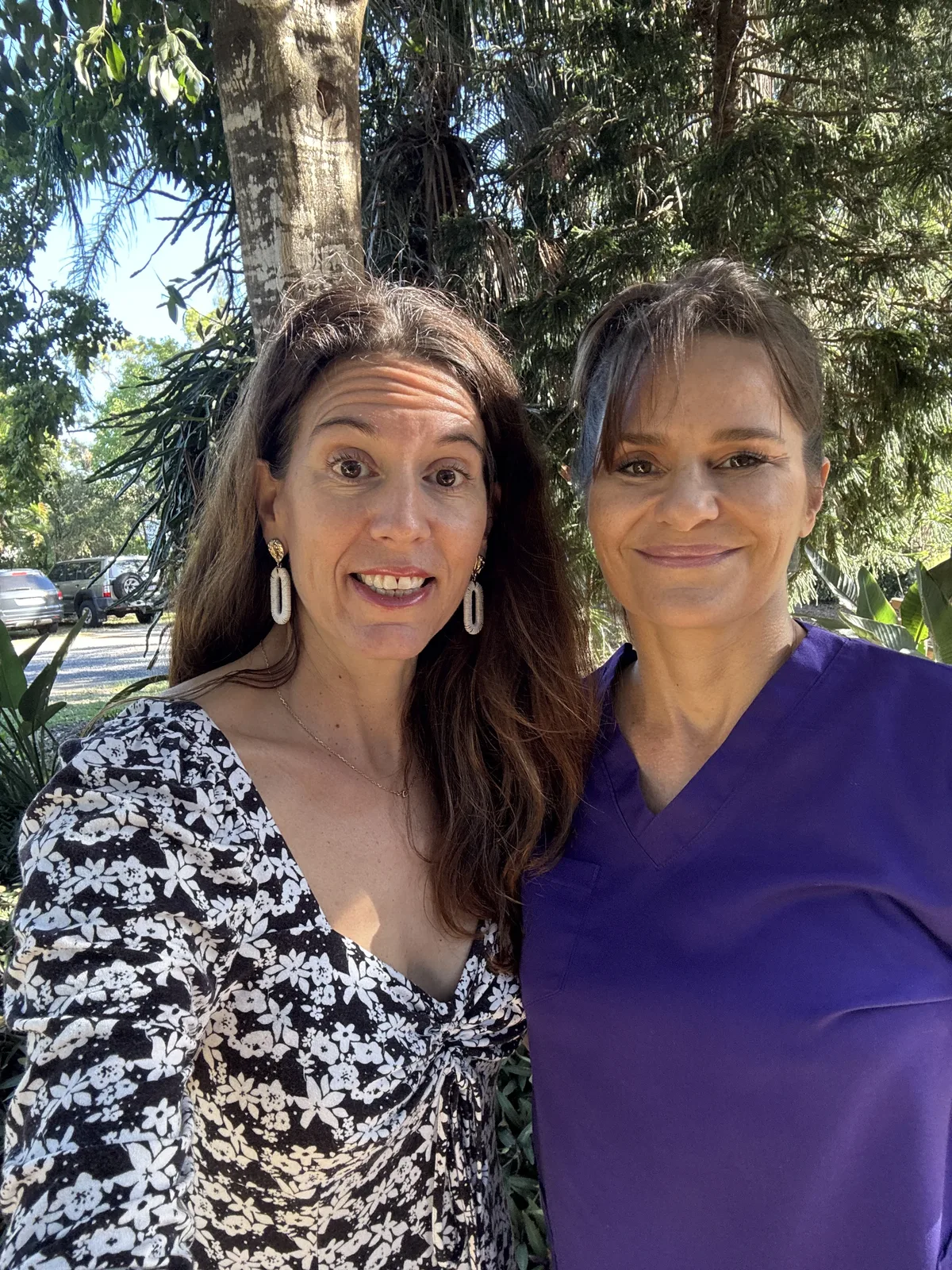
Dr Sandra Skinner has been a GP in Agnes Water, Queensland for years. Agnes Water is three hours return-trip from the nearest psychiatrist. For years she watched patients with clear ADHD presentations get referred out, and wait, or pay, or stop pursuing it entirely.
When the Queensland reforms came through in December 2025, Sandra was clear about what she wanted to build in her own practice. ADHD assessments, done by her, for her patients, at the quality a proper assessment actually requires.
The sticking point was time. A busy regional general practice cannot absorb three or four extra appointments per patient just to manage the paperwork.
So we moved the admin.
Fabienne Wintle, an AI operations architect and founder of Velluto Health, had spent 20 years building operational systems for Australian small operators: the regional tourism businesses, rural operators, and community organisations that major software companies overlook. She applied the same approach to general practice.
Velluto is built on a single principle: engineered for empathy. The name tells the story. Velluto is Italian for velvet: smooth, dignified, without friction. Compassion in healthcare should not be accidental. People with ADHD are often anxious about forms and paperwork, and that is not incidental. It is the condition. Forms require sustained attention, working memory, and sequential processing: exactly the cognitive skills that ADHD affects most. A system that ignores this is not a neutral starting point. It is a barrier.
“With the technology available today, there is no excuse for making it harder than it has to be. Patients complete everything in their own time, on their own phone, before they arrive. That is what engineered for empathy means to us.”
Fabienne Wintle, co-founder, Velluto Health
“It saves me over 50 minutes of admin in the first appointment. In a regional practice three hours from the nearest psychiatrist, that is the difference between offering the service and not.”
Dr Sandra Skinner, specialist GP and clinical co-founder
What a thorough ADHD assessment includes
Clinical guidelines recommend collecting evidence from multiple sources, not from a single appointment. A thorough assessment includes:
- A validated screening questionnaire
- An independent observer report from someone who knows the patient well: a partner, parent, or close colleague
- Childhood evidence: school reports, prior assessments, or parental history
- A review of medical history and current medications
- A clinical interview with a trained GP or specialist
When this evidence is collected and organised before the consultation, the GP can focus the appointment on the patient, not the paperwork.
GPs who offer structured ADHD assessments are listed at myspecialistgp.com.au. The directory also carries articles written by GPs on what to expect from a structured assessment, how to prepare, and what the process looks like. Useful reading for patients and families before a first appointment.
What Velluto does
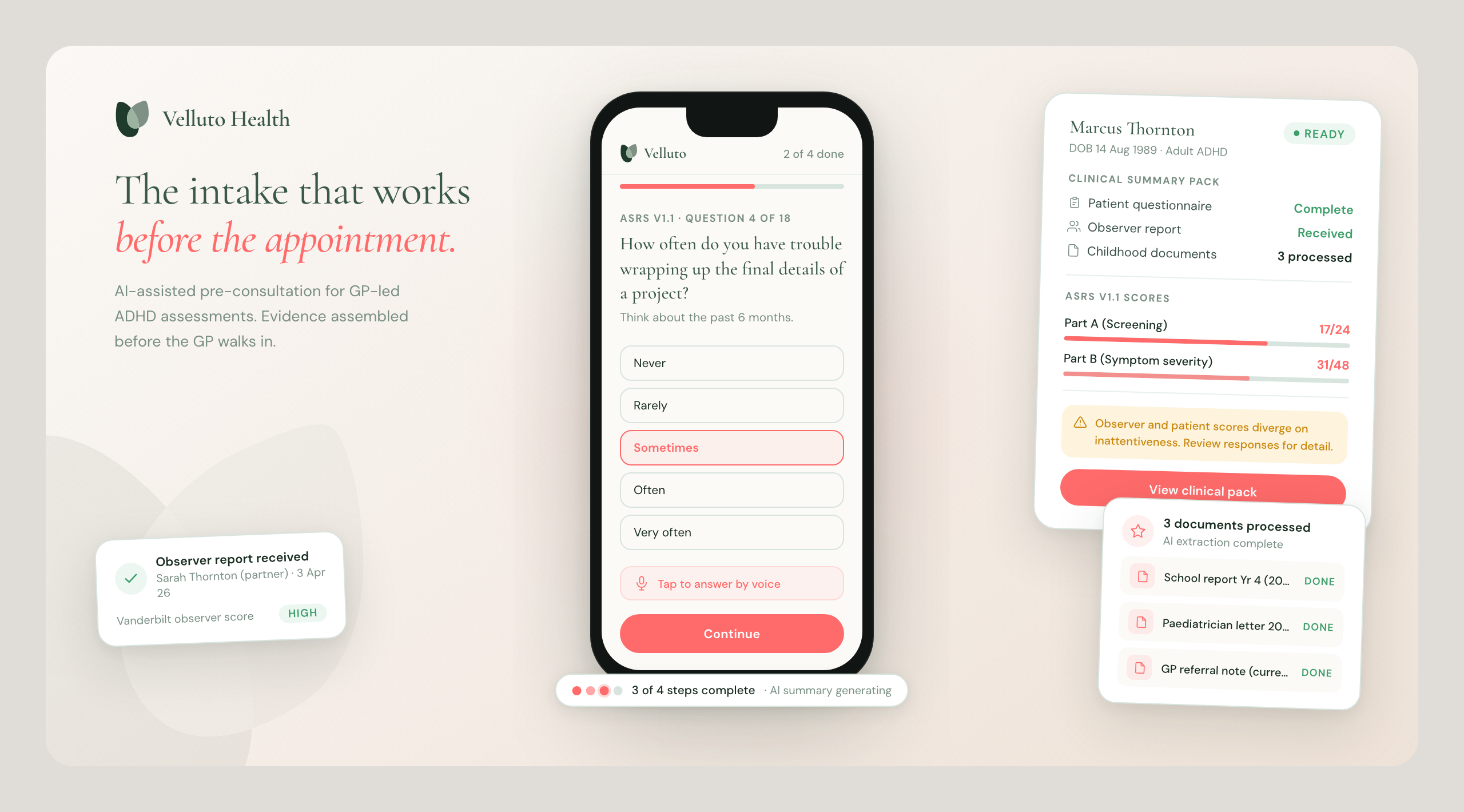
Velluto sits between the booking and the consultation. The platform manages evidence collection automatically: patient questionnaires, observer reports, childhood document upload, and clinical summary assembly. All before the patient arrives.
The GP receives a structured clinical summary before each consultation, with scored questionnaires, observer input, and extracted childhood evidence ready to work from. The summary is downloadable as a PDF for attachment to Best Practice, Medical Director, or any other practice management system.
The software does not diagnose. It gathers, scores, flags, and presents. Clinical judgement remains with the GP.
Velluto costs $99 per month per GP. Admin, reception, and nursing seats are free. There is no per-assessment fee. A 14-day free trial is available at velluto.app.
Platform
Velluto is live across three assessment categories:
- Adult ADHD: validated self-report questionnaire, observer reports, childhood evidence collection, clinical summary
- Paediatric ADHD (ages 6-12): parent and teacher questionnaires, school document extraction, clinical summary
- Paediatric ADHD (ages 13-17): parent and teacher questionnaires, school document extraction, clinical summary
Menopause and perimenopause assessment is in development.
Patient data is hosted in Sydney. The platform has passed a Mozilla Observatory security audit with an A+ score. All uploads are server-side encrypted. The platform is built and operated in Australia.
About Velluto Health
Velluto Health is a pre-consultation clinical intake platform for Australian GPs. The platform collects, organises, and presents patient evidence before a GP-led ADHD consultation begins. It is available at velluto.health and velluto.app.
Media contact
Fabienne Wintle
Founder, Velluto Health
[email protected]
velluto.health
Clinical information disclaimer
This article contains general clinical information for healthcare professionals. It is not a substitute for individual clinical judgement, professional guidelines, or specific patient assessment. Always apply your own clinical reasoning when making treatment decisions.
Velluto is a clinical intake platform. It does not diagnose, recommend treatment, or make clinical decisions. All clinical decisions remain with the treating GP.